


By Olusegun Adeniyi
A few days to the end of their administration in May 2007, then Lagos State Deputy Governor, Mr. Olufemi Pedro, resigned his appointment. But Governor Bola Tinubu refused to accept the letter. Tinubu’s goal was to ensure that the impeachment proceedings commenced against Pedro by the State House of Assembly ran its full course. Pedro’s ‘sin’ was that against the dictates of his boss, he decided to seek the governorship position. First in the defunct Action Congress (AC) and when that door was closed, through the Labour Party. At the election, Pedro predictably failed woefully. But Tinubu felt his “disloyal” deputy should be punished for daring. That was how the state House of Assembly came in. Within a matter of days, a panel was inaugurated by then State Chief Judge, Justice Ade Alabi, a verdict of guilt was established, and the state lawmakers completed the rest by impeaching a man who had already resigned from office!
Pedro’s case is not too different from that of Alhaji Ali Olanusi who was until Monday the deputy governor of Ondo State. Because Olanusi decamped to the All Progressives Congress (APC) on the eve of the presidential election, Governor Olusegun Mimiko’s men in the State House of Assembly met and passed a resolution asking the State Chief Judge to establish an impeachment panel. Before anybody knew what was happening, the “panel” had been constituted, sat, found Olanusi guilty and submitted its report to the lawmakers. All of this within 48 hours! On Monday, Olanusi was impeached and almost immediately, a letter arrived at the State House of Assembly from Mimiko nominating Alhaji Lasisi Oluboyo as his replacement. The letter was approved and the man (who almost prostrated before Mimiko while being sworn in) is now the Ondo State Deputy Governor!
Unfortunately, this is a familiar story across the country where governors dispense with their deputies as casually as most people dismiss their drivers and the charge is that of “disloyalty”, not to the system but to their persons. At last count, no fewer than 18 deputy governors have lost their jobs under the current dispensation due to differences with their governors…
=======================================
Between 30 April 2015, when I wrote the foregoing in my column, ‘The Endangered Spare Tyres’, and today (ten years later), eight more deputy governors have been removed from office after losing the trust of their principals. Ordinarily, a deputy governor should complement rather than merely echo the governor. Unfortunately, under the current dispensation that began in 1999, they have been reduced to no better than political mannequins—present when needed for ceremonies, silent when substantive issues arise, and perpetually walking on eggshells lest their words be misinterpreted as signs of ambition or disloyalty.
As early as August 2001, former Anambra State Governor, Dr Chukwuemeka Ezeife, had described deputy governors as ‘spare tyres’ whose offices exist at the pleasure of state chief executives. Incidentally, he spoke at the opening ceremony of a two-day seminar on the role of deputy governors in a presidential system of government. It’s almost as if the late Ezeife—who was at that period Special Adviser on Political Affairs to President Olusegun Obasanjo—wrote the manual on how governors should treat their deputies. No one is perhaps in a better position to explain this complexity than the former APC National chairman, Dr Abdullahi Ganduje, who was deputy governor in Kano State (to Dr Rabiu Musa Kwankwaso) for two terms and a governor for two terms. In August 2023, Ganduje disclosed that he was writing a book, titled ‘Deputising and Governance in Nigeria’, to share insights on the issue. “My book is not dwelling on governors and deputies alone. It includes presidents and vice presidents, considering what happened between Olusegun Obasanjo and Atiku Abubakar,” Ganduje said.
While we await Ganduje’s book, we must admit that the reciprocal relationship between an elected political figure (president or governor) and their deputy is a distinct partnership that presents unique challenges. In Nigeria, it often involves dealing with mischief makers and rumour mongers, managing public perceptions and navigating a complex relationship with those around the principal—including desperate influence peddlers, ambitious politicians who eye the office and errant family members.
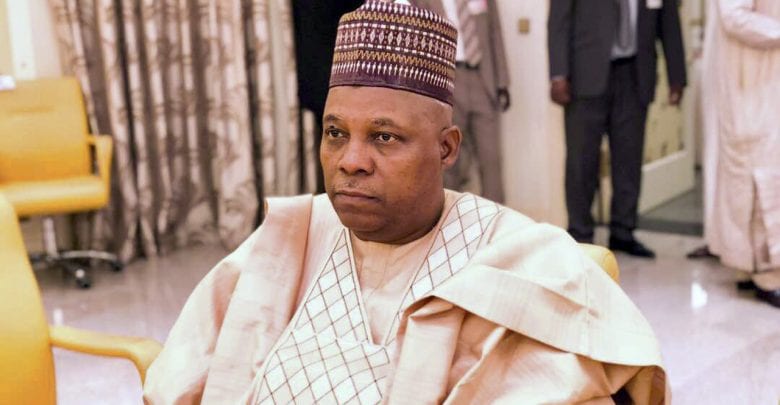
In giving a befitting burial to his late predecessor, President Tinubu has demonstrated what a united government could achieve by assigning important roles to Vice President Kashim Shettima. But even that is not enough to douse the unhelpful speculation of recent weeks. Many would recall that on 21 June, presidential spokesman, Mr Bayo Onanuga, publicly dismissed claims suggesting a rift between the duo. This followed the omission of Shettima’s name during the recent endorsement of Tinubu for a second term by North-East stakeholders in Gombe, sparking tension at the event.
In his interview with Channels Television, Onanuga explained, and quite correctly, that the choice of a running mate is the prerogative of the candidate after nomination. But Onanuga also addressed the reputational issue regarding his principal which may have instigated the agitation. “Yes, when he (Tinubu) was governor, there were issues. In his first term, he and his deputy, Kofo (Bucknor-Akerele) did not get along, and she had to leave. Femi Pedro replaced her. In the second term, he retained Pedro, but Pedro later defected because he wanted to be governor. That is why he had to go. I do not want to reopen old wounds, but that is what happened,” said Onanuga who rejected the notion that Tinubu “has a pattern of discarding deputies. Each instance was shaped by unique political circumstances.”
The intervention by Onanuga is significant because it goes to the real issue of the role of deputies in Nigeria’s political environment. “In this country, deputy roles, whether as deputy governors or vice presidents, are always surrounded by rumours. Even when there is no conflict, people around them manufacture stories,” Onanuga said. “But as far as I know, Tinubu and Shettima work together very well.”
Instructively, two weeks after Onanuga’s intervention, the ‘debate’ was reopened following Shettima’s remarks at the public presentation of ‘OPL 245: The Inside Story of the $1.3 Billion Oil Block’, written by former Attorney General and Justice Minister, Mohammed Bello Adoke, SAN. What was no more than an expression of gratitude to the author was quickly weaponized into evidence of disloyalty to the president. Some of the commentaries that followed offer a masterclass in the peculiar dynamics that define the number two position in Nigerian politics. They also reveal the impossible tightrope that Nigerian deputy governors and vice presidents must walk.
Here was Shettima, doing what any reasonable person would do at a book launch, by sharing a personal anecdote that illustrated the author’s character and influence. His recounting of how Adoke, alongside others including then House of Representatives Speaker, Aminu Tambuwal, helped to forestall his removal as Governor of Borno State, was both relevant to the occasion and historically significant. Yet within hours, these remarks were twisted into an indirect criticism of presidential power, a veiled commentary on the suspension of Rivers State Governor SiminalayiFubara, and a subtle rebellion against his own principal.
When a sitting vice president cannot acknowledge past kindness without triggering speculation about present loyalties, we have created an environment that stifles rather than strengthens democratic governance. The tragedy is not just in the mischief of misinterpreting Shettima’s comment, but in how this reflects our political culture of failing to distinguish between legitimate public discourse and palace intrigue. The fact that Shettima’s office felt compelled to issue a clarification speaks to how even the most innocuous statements can be transformed into political weapons by those who profit from manufacturing discord. If a vice president cannot safely reference his own political history at a literary event without sparking a loyalty test, what does this say about the space for independent thought in a democracy?
The irony is that Shettima’s remarks demonstrated the kind of institutional memory and personal relationships that strengthen rather than weaken governance. His acknowledgment of Adoke’srole during a difficult period, his recognition of political figures who acted on principle rather than partisanship, and his willingness to engage with Nigeria’s complex political history should be seen as assets to the current administration. Instead, they were treated as potential liabilities by commentators more interested in sensationalism than substance. Sadly, such situations have led to the fall of many deputy governors under the current dispensation.
In the United States, from where we copied the presidential system of government, the role of the vice president has evolved over the past three centuries. Initially, the office was reserved for whoever finished second in the presidential race. But the 1800 presidential election threw up very interesting outcomes and was stalemated in Congress for several months, because Thomas Jefferson of the Democratic-Republican Party and Aaron Burr of the Federalist Party (the two leading parties at the time) each won 73 electoral votes. That episode necessitated the 1804 constitutional amendment which eventually culminated in a presidential candidate forming a joint ticket with a chosen vice-presidential nominee.
To date, 15 American vice presidents have become president. While eight were elevated after their principals died, six have been elected, with the latest being Joe Biden, who had a four-year gap between the two jobs. Gerald Ford, of course, assumed the presidency in 1974 after Richard Nixon resigned in the wake of the Watergate scandal. Nixon himself had been VP to President Dwight Eisenhower between 1953 and 1960 before he was eventually elected president eight years later in 1968.Interestingly, Nixon is also on the list of incumbent vice presidents who failed in the elections to succeed their principals. Others were John Breckinridge in 1860, Hubert Humphrey in 1968, Al Gore in 2000, and Kamala Harris in 2024. Meanwhile, by the US constitution, the vice president is the presiding officer in the Senate with tie-breaking power, but they also play executive roles.
Perhaps the real burden of being number two in Nigeria is not just the constant scrutiny but the way that often misses the point entirely. While we obsess over imagined slights and manufactured controversies, we lose sight of what a vice president or deputy governor could contribute to governance. Until we develop the political maturity to distinguish between legitimate expression and disloyalty, between historical reflection and present criticism, we will continue to handicap these important constitutional offices with unnecessary drama and misplaced suspicion.
Source: Thisday

Comments are closed.