
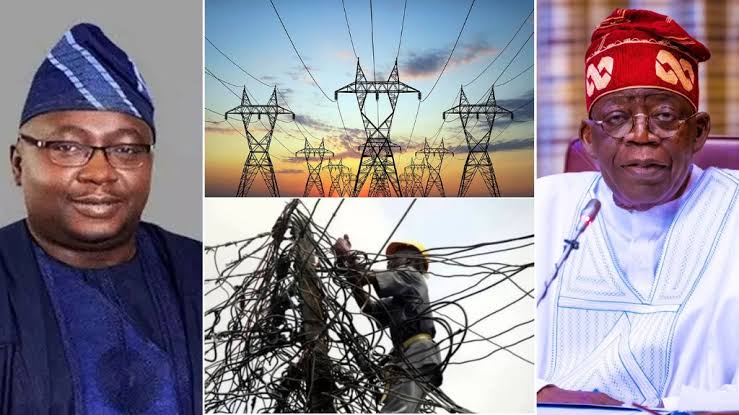
DEBT CRISIS KEEPS NIGERIANS IN DARKNESS AS TINUBU APPEALS FOR PATIENCE ON 4 TRILLION NAIRA POWER SECTOR LIABILITY

*By Ade Adesokan*
Nigeria’s persistent epileptic power supply continues to plague millions of citizens across the nation and recent developments have shed light on why the problem remains seemingly intractable despite repeated government assurances.
At the heart of the current crisis which is beyond the 11 DISCO lies a staggering debt burden of approximately ₦4 trillion owed to power generation companies and gas suppliers, a financial albatross that has crippled the sector’s ability to function optimally.
While President Bola Ahmed Tinubu has given what officials describe as anticipatory approval for a bond programme to address this massive liability, the conditional nature of this approval and the ongoing verification process mean that actual relief remains frustratingly out of reach for the struggling operators who keep the lights on.
The magnitude of the problem became clearer during a recent high-level meeting in July 2025 at the Presidential Villa in Abuja, where President Tinubu hosted members of the Association of Power Generation Companies in a session that underscored both the gravity of the situation and the government’s cautious approach to resolving it.
The delegation, led by retired Colonel Sani Bello and including prominent private sector figures such as Tony Elumelu, Chairman of Heirs Holdings and Transcorp Power and Kola Adesina, Group Managing Director of Sahara Group, came seeking concrete action on debts that have accumulated over more than a decade of unfunded tariff shortfalls and market deficits. What they received instead was an appeal for patience, though one accompanied by assurances of the administration’s commitment to finding a lasting solution.
President Tinubu’s message to the power generators was measured and pragmatic, acknowledging the legitimacy of their claims while emphasizing the need for due diligence. He made it clear that his administration accepts responsibility for liabilities inherited from previous governments, but stressed that any payment must be preceded by thorough verification and validation to ensure credibility and transparency.
The President explained that audit and legal teams are currently working to scrutinize the claims, a process that inevitably takes time but is essential to prevent any misappropriation of public funds or payment of inflated or fraudulent claims.
This verification requirement, while administratively sound, effectively means that the money remains locked away even as generation companies struggle with their own obligations to gas suppliers, equipment manufacturers and financial institutions.
The appeal for patience extended beyond the power generators themselves to the banking sector, which holds significant exposure to the industry through loans and credit facilities extended to these companies.
In remarks that revealed the precarious financial position of many operators, President Tinubu specifically urged financial institutions to refrain from foreclosing on assets, using the metaphor of sharpening pencils but keeping erasers handy as a call for flexibility and forbearance. This plea suggests that some generation companies may be perilously close to default, with their creditors contemplating seizing physical assets to recover outstanding debts, a scenario that would further devastate the already fragile power sector.
Mrs. Olu Verheijen, the President’s Special Adviser on Energy, provided additional context during the meeting, explaining that the four trillion naira bond programme has received anticipatory approval from President Tinubu but remains subject to final verification before any funds can be disbursed through the Debt Management Office.
She revealed that verified claims have already reached one point eight trillion naira, with total obligations as of April 2025 standing at ₦4 trillion, a figure that encompasses over a decade of accumulated debt stemming from the fundamental dysfunction of Nigeria’s electricity market.
The government has engaged with the 27 generation companies to review Power Purchase Agreements and gas supply contracts dating back to 2015, a painstaking process that may ultimately result in the total debt figure being revised downward depending on what the final validation uncovers.
This conditional and incremental approach to debt resolution, while fiscally prudent, does little to address the immediate operational challenges facing power generators and gas suppliers who need cash flow now to maintain and expand their facilities. The reality is that these companies have continued to generate electricity and supply gas despite not being paid in full for years, effectively providing vendor financing to the government and to the distribution companies that owe them money.
This unsustainable situation has created a vicious cycle where generators cannot invest in maintenance or new capacity because they lack the funds, leading to frequent breakdowns and reduced generation capacity, which in turn means less electricity available for DISCO and consumers, perpetuating the epileptic supply that has become Nigeria’s unfortunate hallmark.
Gas suppliers find themselves in a particularly difficult position, as they must pay upstream producers for gas even when they themselves have not been paid by the generation companies, creating a chain of indebtedness that ripples through the entire energy value chain. Many have been forced to reduce or halt supplies, directly impacting the amount of electricity that can be generated regardless of the theoretical capacity of the power plants. This gas-to-power constraint remains one of the most immediate bottlenecks in the system and one that cannot be resolved through long-term verification processes or future bond issuances.
The broader context of this debt crisis reveals deeper structural problems in Nigeria’s electricity sector that go beyond simple non-payment.
The unfunded tariff shortfalls that Mrs. Verheijen referenced stem from the government’s longstanding practice of setting electricity prices below cost-recovery levels for political and social reasons, creating an artificial gap between what power producers should receive and what they actually get paid. For years, successive administrations have been reluctant to implement tariffs that reflect the true cost of electricity generation, fearing public backlash and social unrest, yet this populist approach has merely shifted the burden onto the generation companies and their creditors while failing to deliver reliable power to the very citizens the policy purportedly protects.
The anticipatory approval granted by President Tinubu, while representing acknowledgment of the problem, falls short of being the definitive solution that the sector desperately needs. The term itself suggests that this is not yet a firm commitment but rather an indication of intent subject to various conditions and approvals. For generation companies operating on the edge of financial viability, such conditional assurances provide little comfort when they must meet payroll, service debt, purchase spare parts, and maintain operations with insufficient revenue.
The gap between anticipatory approval and actual disbursement can span several months or even years, during which time the situation continues to deteriorate and directly impacting the electricity consumers nation wide.
Furthermore, even when the verification process is complete and bonds are eventually issued, questions remain about the liquidity and marketability of these instruments.
Government bonds are only as valuable as investors’ confidence in the government’s ability and willingness to honour them and Nigeria’s fiscal challenges and history of debt servicing difficulties may mean that these bonds trade at significant discounts to their face value, providing generation companies with less relief than the nominal figures suggest. If the companies are forced to sell these bonds at a discount to raise immediate cash, they effectively take another haircut on money already owed to them for services already rendered.
The persistence of epileptic power supply in Nigeria can therefore be directly traced to this liquidity crisis and the government’s inability or unwillingness to resolve it decisively.
While President Tinubu’s administration deserves some credit for engaging with stakeholders and acknowledging the problem, the appeal for patience rings hollow to a population that has been patient for decades without seeing meaningful improvement in electricity supply.
The verification and validation process, however necessary from a governance perspective, effectively kicks the can down the road while the fundamental problems continue unabated.
What makes the situation particularly frustrating is that Nigeria possesses substantial gas reserves and has built significant generation capacity over the years, suggesting that the technical capability to provide stable electricity exists.
The problem is not primarily one of resource availability or technical know-how but rather of financial architecture and political will. The government’s reluctance to implement cost-reflective tariffs, combined with its failure to honour payment obligations under existing agreements, has created an environment where rational private sector actors cannot sustainably operate. This explains why, despite privatization of the generation and distribution segments of the power sector years ago, performance has not improved significantly, as the underlying financial dysfunction remains unreformed.
As long as generation companies and gas suppliers remain underpaid or unpaid for their services, as long as government approvals remain anticipatory rather than definitive and as long as verification processes stretch on indefinitely while operational needs remain immediate, Nigeria’s epileptic power supply will persist.
The ₦4 trillion debt represents not just a historical liability but an ongoing impediment to sector functionality, and until this burden is genuinely lifted rather than merely acknowledged, the dreams of stable, reliable electricity for Nigerian homes and businesses will remain just that—dreams deferred by financial constraints and bureaucratic processes while the lights continue to flicker and fail with depressing regularity across the nation.
*_Ade Adesokan is a public affairs commentator and international human rights advocate_*

Comments are closed.