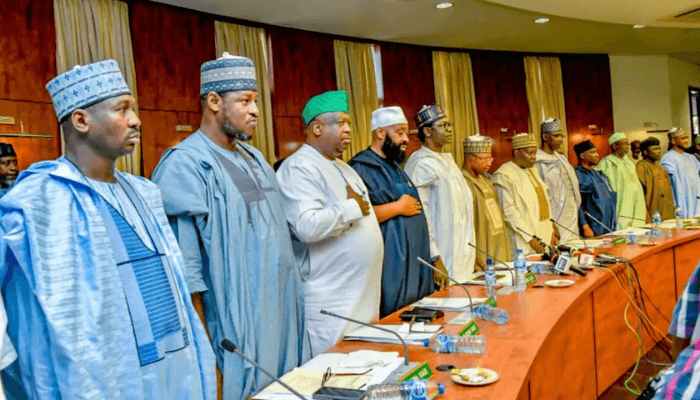

How Northern Governors allocate Money for Heaven While Kids Roam the Earth uneducated
A Report on the Investigation
The Numbers That Should Keep Governors Up at Night
An accountant in one of northern Nigeria’s huge bureaucracies sits with a calculator and a clear mind. His job is easy: give away billions. UNICEF, the United Nations Children’s Fund, has made a decision that should scare every public official in the area. Nigeria now has the sad honour of having more kids out of school than any other country in the world. As of late 2024, the number is 18.3 million, and that is, one in every five children who aren’t in school lives in Nigeria.
But this is where the maths gets really weird. UNICEF’s June 2025 Humanitarian Situation Report says that 45% of these kids live in the Northwest and 28% live in the Northeast. That means that 73% of Nigeria’s educational disaster is above the middle belt. In Yobe and other states, 43% of kids never go to school. Zamfara comes in second with 41 percent, and Sokoto comes in third with 37 percent. A 2018 study by the Universal Basic Education Commission found that 66 percent of all out-of-school children in Nigeria live in the North-East and North-West regions.
Based on these numbers, one would think that state governments would put all of their kobo into classrooms, teachers, and textbooks. One would be very wrong. The governors of the region have found more important things to do, like pilgrimage seats, mass weddings, and security votes that are so big they could pay for small countries. As they say, the house is on fire. And the budgets are getting scented candles.
The Kebbi Hajj Spectacular: Ten Billion Naira to Heaven
The Kebbi State Government made what it called a “decisive, compassionate, and people-centered intervention” on December 7, 2025. Governor Nasir Idris had given the State Pilgrims Welfare Agency ten billion naira to help them. What is the purpose? To get 1,300 more seats for the Hajj pilgrimage to Saudi Arabia in 2026.
Give that number a moment to sink in. Ten billion naira. For seats on the pilgrimage. For the 2026 exercise, the National Hajj Commission of Nigeria (NAHCON) gave Kebbi State 3,300 seats. Only 2,110 people who wanted to go on the pilgrimage were able to pay their fares before the deadline. The state government stepped in with public money when they thought they might lose the rest of the seats. The state would rather spend ten billion naira than let any pilgrim miss their spiritual journey. Each seat costs about 7.6 million naira.
The International Centre for Investigative Reporting figured that this one payment makes up about 59% of Kebbi’s total revenue for 2024. A SaharaReporters review showed an even worse picture: between January and September 2025, Kebbi State only made fourteen billion naira in IGR. So, the Hajj allocation takes up 71.4 percent of the state’s own revenue for nine months.
Now think about what else you could buy with ten billion naira. The same state’s budget documents say that the Ministry of Water Resources only got 86 million naira for capital spending during the same time. The budget for building boreholes was two million naira. If you do simple maths, you can see that the Hajj money could pay for 5,000 boreholes in the state. The budget for building a clinic is 20 million naira, so the pilgrimage money could build 500 health centres. The Hajj fund could buy furniture and other things for 1,300 schools, since it gave 100 million naira to 13 schools.
Alhaji Faruku Aliyu-Yaro, the Chairman of the Pilgrims Welfare Agency, thanked the governor for his “foresight and support.” He said that without this help, Kebbi might have lost the unpaid seats. He went on to say that the state started getting ready for the 2026 Hajj “about seven to eight months ago” and hopes to stay “the best state in preparation, operation, and conduct of the Hajj exercise across Nigeria.” The worst numbers for school attendance. The irony is clear.
Two Point Five Billion Naira for a Happy Marriage
Kano State has put a lot of money into earthly unions, while Kebbi’s priorities seem to be more about the afterlife. The state budget for 2025, which was signed into law on December 20, 2024, and totals 719.75 billion naira, has an interesting line item: 2.5 billion naira for quarterly mass weddings in all 44 local government areas.
Musa Shanono, the State Commissioner for Planning and Budget, revealed this allocation while going over the budget. The mass wedding project is part of the governance and service delivery sector, which got 91.32 billion naira for a number of social programs. The government says it wants to create “a fair society for sustainable growth” and “responsibility, openness, and the defence of human rights.” One would think that sustainable growth means more people living in the country.
The Hisbah Board, which is Kano’s sharia enforcement agency, said that by October 2025, they would be holding a mass wedding ceremony for at least 2,000 couples. Sheikh Mujahid Aminudeen, the Deputy Commander-General, said that the program is for “vulnerable women, including widows, divorcees, and spinsters.” All couples who want to get married must register with the Hisbah Board and go through a medical screening.
The Kano government isn’t just stopping at weddings. The same budget sets aside 1 billion naira for feeding programs during Ramadan and 955 million naira for surveys of the workforce, general household surveys, and counting children who are not in school. It seems almost poetic that it costs less to count kids who aren’t in school than to marry them off. The budget also sets aside 267.6 million naira to make an Islamic calendar, help Da’wah programs, and give new converts to Islam welfare packages.
The mass wedding budget is about 10% of a single month’s federal spending, which is about 25 billion naira in Kano’s July 2025 FAAC allocation. It all depends on how you define “necessity” whether or not this is good governance. The kids who aren’t in school yet might see things differently.
The Ministry of Religious Affairs: A Growing Business
Katsina State has turned spending on religion into an art form in its own right. The state’s approved budget for 2025 shows a religious governance structure worth billions of naira, which would pay for major improvements to healthcare in most countries. The Pilgrims Welfare Board got 4.58 billion naira by itself. The total for the Ministry of Religious Affairs is 4.79 billion naira. With 35 million naira for the Hisbah Board and 155 million naira for the Zakat and Endowment Board, you have a religious bureaucracy that is very rich.
According to Premium Times, Katsina also set aside 2.3 billion naira to buy food for Ramadan. This isn’t charity from private funds; it’s public money set aside for religious observance during the holidays. No one seems to be asking whether states should be paying for religious activities on this scale when basic services aren’t being funded.
The Punch newspaper said that more than 16 billion naira was approved for Ramadan palliatives and food in a single cycle across several northern states. The breakdown looks like a spending spree: Sokoto at 1.28 billion naira, Jigawa at 4.8 billion naira, Katsina at 2.3 billion naira, and Kano at 8 billion naira. These donations are not optional. These are line items in official government budgets that have been approved by state assemblies and are paid for by federal funds and money made by the government itself.
The budget for Zamfara State in 2025 has a clear line item for “Construction/Provision of Emir’s Palace” that costs one billion naira. It seems that traditional rulers need fancy places to live that are paid for by the government, while regular people don’t have basic needs met. The same budget sets aside 550 million naira for “Special Days/Celebrations,” another category that is perfect for spending money without having to explain why.
The Great Black Hole: Fifty-Six Billion Naira in Security Votes
If spending on religion is one kind of crazy spending, security votes are a whole other kind of crazy spending. A Saturday Punch investigation found that in the first nine months of 2025, 14 northern states gave their governors a total of 56 billion naira as security votes. These funds kept coming in even as murders, kidnappings, and attacks on communities grew in the area.
Borno State is at the top of the list, having spent a shocking 32 billion naira out of a planned 41.6 billion naira. For comparison, Borno’s FAAC allocation for July 2025 was about 15 billion naira. The security vote release for nine months is 211 percent of the federal allocation for one month. Yobe spent 5 billion naira out of a 5.7 billion naira budget, Adamawa spent 4.5 billion out of a 10.7 billion naira budget, and Nasarawa spent 4.39 billion naira, which was more than its 4 billion naira budget.
The pattern continues throughout the area. Katsina let go of 3.1 billion naira out of 4.4 billion, Jigawa let go of 2.4 billion out of 2.9 billion, Zamfara let go of 1.5 billion out of 8 billion, and Kebbi let go of 1.49 billion out of 3 billion naira. Taraba released 55 million naira, Kaduna released 349 million naira, and Kogi released 192 million naira.
What the Punch investigation couldn’t find may be the most damning thing. Bauchi, Kano, Niger, Plateau, and Sokoto are five states that did not say how much they spent on security votes. Governments won’t say how much they spend fighting insecurity in a region where it is supposedly the main problem. The point is that it is unclear.
According to Transparency International, security votes in Nigeria are like a “cancerous tumour in the state budget.” They are monthly cash payments to governors that are supposed to be used for urgent security needs but are never checked. There are no details on how the money was spent. No public scrutiny is needed. Governors can take out billions of dollars without breaking any laws. According to Transparency International, Nigeria spends more than $670 million a year on security votes, which is more than the total budgets of the Army, Navy, and Air Force. But things are getting worse.
It couldn’t be more ironic. On November 21, 2025, 315 students and 13 teachers were taken from St. Mary’s Catholic School in Papiri, Niger State. On November 17, 26 schoolgirls were taken from Government Girls Secondary School in Maga, Kebbi State. These things happened in states that get billions of dollars in security votes. The National Bureau of Statistics gave a number so shocking that it should have set off a national emergency: 2.2 million Nigerians were kidnapped between May 2023 and May 2024, with most of them coming from the North.
The Federal Allocation Context: Where the Money Comes From
To understand these spending choices, you need to know how much money the federal government actually sends to these states. The Federation Account Allocation Committee (FAAC) gives states their share of oil revenue and other federal money every month. The Accountant-General’s Office publishes these numbers, which show how many resources are available.
The 19 northern states got the following amounts of money in July 2025: Adamawa 11.6 billion naira, Bauchi 13 billion, Benue 13.9 billion, Borno 15.2 billion, Gombe 7.1 billion, Jigawa 14.6 billion, Kaduna 15.6 billion, Kano 26.6 billion, Katsina 19 billion, Kebbi 11.7 billion, Kogi 12 billion, Kwara 8.9 billion, Nasarawa 7.7 billion, Niger 14.1 billion, Plateau 10.4 billion, Sokoto 13.3 billion, Taraba 9.2 billion, Yobe 9.8 billion, and Zamfara 9.3 billion naira. These numbers stay the same every month. They can be counted on. They are meant to pay for government.
Kebbi spends 10 billion naira on Hajj seats, which is 85% of what the federal government gives them in a month. Kano’s 8 billion naira budget for Ramadan feeding is 32% of what it gets from the FAAC each month. That’s 33% of the monthly federal funds that Jigawa gets when it gives 4.8 billion for the same thing. The numbers are not secret. They are open to the public. It doesn’t seem to bother anyone in charge.
What the Kids Never Asked For
It is easy to see the maths behind moral failure. About 73 percent of the kids in Nigeria who are not in school live in the north. These same states spend billions on security votes, mass weddings, religious ministries and pilgrimage support while schools fall apart and teachers leave. The North-East and North-West have female primary net attendance rates of 47.7% and 47.3%, which means that more than half of girls never go to school. In the Northeast, 2.8 million kids need help with education in emergencies. At least 802 schools are still closed, 497 classrooms have been destroyed, and 1,392 classrooms have been damaged but can be fixed.
People who support these allocations will say that pilgrimage support is a religious duty, that mass weddings stop social problems, and that security votes are needed because of the violence in the area. These arguments might be more convincing if the same governments showed any concern for education, healthcare, or the supply of water. No, they don’t. The national budget for 2025 only set aside 7.3% for education, which is much less than what is typical in other countries. States in the area do worse.
This isn’t a problem with culture or religion. It’s a problem with public money that looks like it’s about religion. When governments spend more money sending adults to Mecca than keeping kids in school, they have made a choice. When billions of dollars go to mass weddings but classrooms don’t have enough desks, it’s clear what the priorities are. When security votes take up hundreds of percent of monthly budgets and kidnappings happen more and more, the contradiction is clear.
Jamilu Charanchi, the National Coordinator of the Coalition of Northern Groups, said he was upset that attacks “are still escalating” even though the government has given them 56 billion naira in security votes. He said that banditry “has become an industry where many people benefit, either directly or indirectly,” and that some officials “will never allow it to end.” Whether this claim is true or not, the result is clear: money flows, insecurity continues, and children stay uneducated.
Cristian Munduate, UNICEF’s representative in Nigeria, said it clearly: “It is our shared responsibility to keep our children safe in schools.” The children who are wandering the streets of Kano, the girls who are married off before finishing primary school in Kebbi, and the boys who are recruited into banditry in Zamfara did not choose their fate. Their governors did. Every budget line that puts pilgrimage ahead of education, wedding ceremonies ahead of water supply and security votes ahead of school buildings makes the choice again.
The 10 billion naira for Hajj seats in Kebbi, the 2.5 billion for mass weddings in Kano, and the 32 billion released as Borno’s security vote are not just numbers. They stand for roads that weren’t built, hospitals that weren’t stocked, teachers that weren’t hired, and kids that weren’t taught. They are a political class that has found a good way to keep people happy: keep them spiritually satisfied and married while the foundations of society fall apart.
People like Alhaji Faruku Aliyu-Yaro will keep praising governors for their “foresight and support” in getting pilgrimage seats. The Sheikh Mujahid Aminudeens will keep putting together big weddings for thousands of couples. The budget papers will keep giving billions to religious groups, traditional institutions, and secret security votes. And tomorrow, another child in northern Nigeria will wake up without a school to go to, a future to look forward to, or a seat saved for them.
There is a fire in the house. The budgets are still getting scented candles. And the accountant with a clear conscience keeps giving away billions.
Colin Bine
December 16, 2025