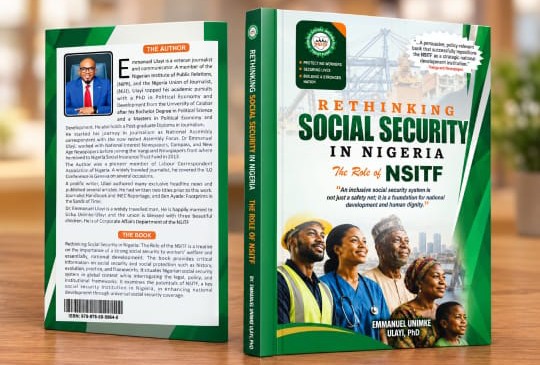

NSITF in Focus: Dr. Emmanuel Ulayi Argues Social Security is Key to National Growth in New Book

ABUJA. A new 2026 treatise by Dr. Emmanuel Ulayi is making a bold case for repositioning social security as a central driver of Nigeria’s national development, rather than a peripheral welfare program.
The book, titled Rethinking Social Security in Nigeria: Role of the NSITF, examines how institutions like the Nigeria Social Insurance Trust Fund can move beyond compensation to become strategic tools for inclusive growth, human capital protection, and institutional resilience.
Structured into 16 chapters, the book provides a comprehensive analysis of Nigeria’s social protection landscape. It covers historical foundations, legal and policy frameworks, institutional architecture, and modern trends shaping social security globally and locally.
Key sections include: Social Security and Social Protection in Context, Evolution of the Nigeria Social Insurance Trust Fund, Legal and Policy Framework of Nigeria’s Social Security System, The Renewed Hope Agenda: Implications for Social Security, and _Leadership and Institutional Transformation: Effects of the Faleye-led Management.
Other chapters explore Institutional Architecture of Social Protection in Nigeria, Challenges in the Nigerian Social Security System, Leadership Perspectives: Selected Leaders’ Thoughts on Social Insurance, and The Future of Social Security/Protection in Nigeria. The final chapter, “A Recap”, summarizes the core arguments.
The Heart of the Argument
Chapter 11, “Social Security as a Driver of National Development,” forms the conceptual core of the book. Here, Dr. Ulayi argues that social security institutions such as NSITF should be viewed as productive investments, not fiscal burdens.
He defines national development as multidimensional, encompassing economic growth, social progress, political stability, human capital development, and environmental sustainability. Within this framework, he positions the Employees’ Compensation Scheme administered by NSITF as critical to labour market efficiency, risk management, and economic resilience.
The argument aligns with global standards set by the International Labour Organization and the World Bank, both of which link social protection to poverty reduction and sustainable development. Dr. Ulayi also grounds his analysis in domestic law, particularly the Employees’ Compensation Act, 2010, and international instruments like ILO Convention No. 102 and the Sustainable Development Goals.
This is especially significant in Nigeria, where social security is often misconstrued as charity or reduced to pension payouts.
Nine Developmental Roles Identified
The book systematically outlines nine key roles through which social security contributes to national development. The first, Poverty Reduction and Income Security, highlights how social protection shields households from falling into poverty due to shocks such as workplace injury, illness, or loss of income.
Subsequent chapters are expected to expand on the other eight roles, with implications for policy design and implementation.
With its blend of historical context, legal analysis, and policy recommendations, Rethinking Social Security in Nigeria comes at a time when the Tinubu administration’s Renewed Hope Agenda is placing renewed emphasis on social investment and human capital development.
The book positions NSITF and the broader social protection system as essential pillars for achieving those goals.