

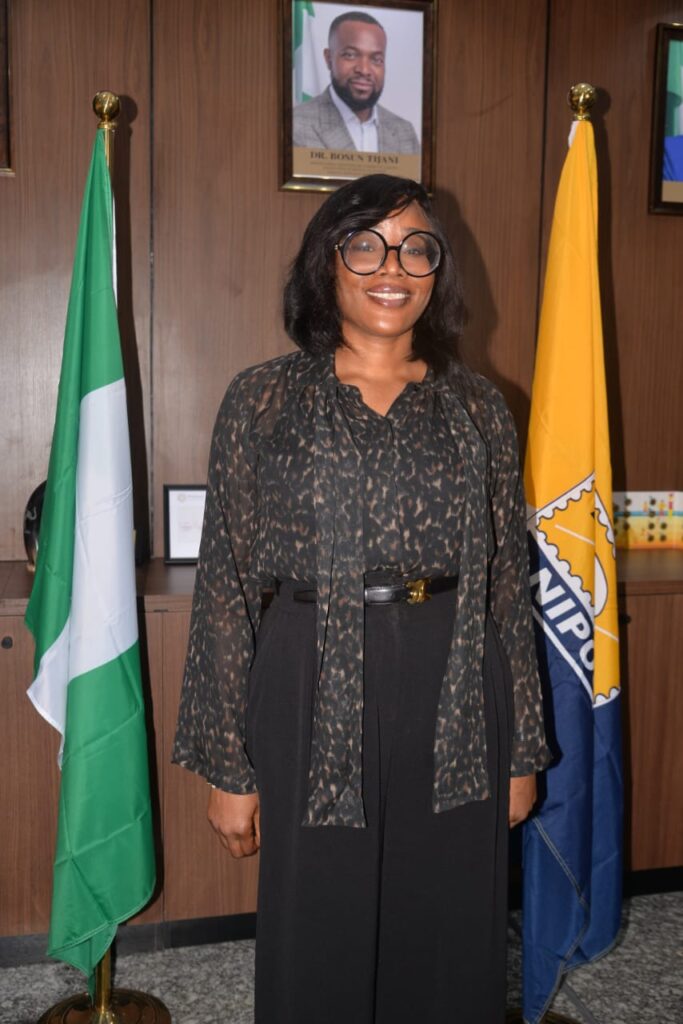
Nothing in her simple ambience exposes the brilliance and forceful persona that her presentations reveal.
As one of President Bola Ahmed Tinubu’s young female appointees, Tola Odeyemi surely knows her onions. She was appointed to head the Nigerian Postal Service as Nigeria’s first female Postmaster General at the inception of this administration. But anyone who can read between the lines will tell you something unusual seems to be happening at the new NIPOST. The place is upbeat and it is obvious like a pregnant woman, that everyone is expectant of something new.
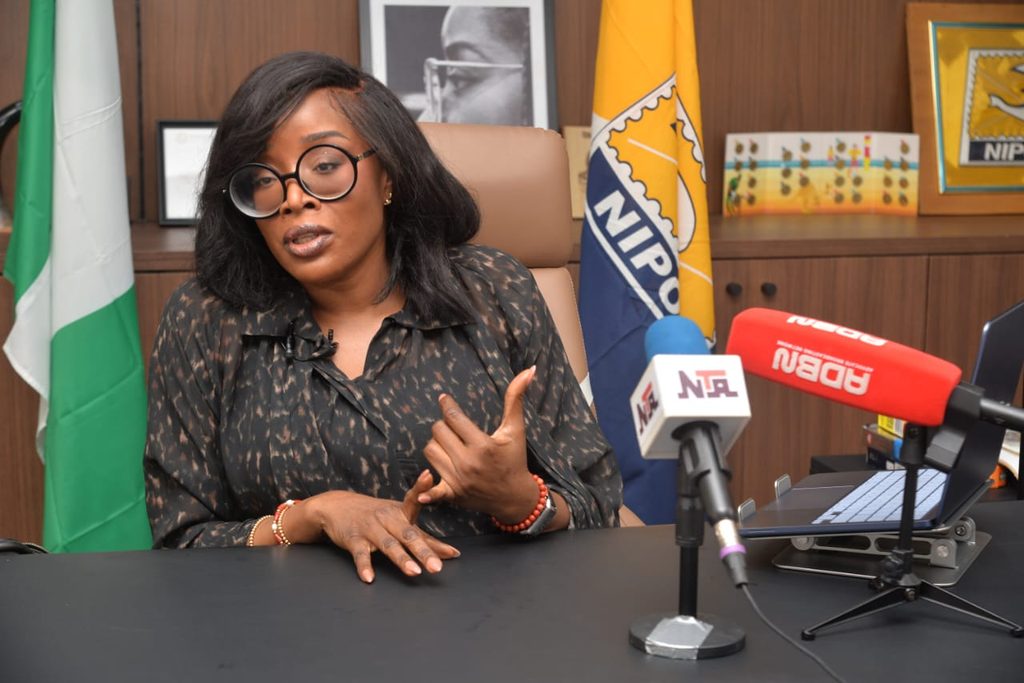
Buoyed by the vive and panache in which she has carried her duties, workers now believe a new NIPOST is possible and they have seemingly keyed into the reforms she’s championing.
In an interview session, she spoke passionately about the National Digital Alphanumeric Postcode System which was recently unveiled, bringing hope to those who think NIPOST is forlorn, handling the illegal courier firms and her four-pronged strategies for making the organization self-sustaining.
Excerpts:
PLEASE ENLIGHTEN US MORE ABOUT THE NEW NATIONAL DIGITAL ALPHANUMERIC POSTCODE SYSTEM AND WHAT PROGRESS YOU HAVE RECORDED SO FAR.
The whole concept of a National Digital Alphanumeric Postcode was designed and approved in 2009 by the Federal Executive Council. The Postcode was conceived as a part of a 3-pronged solution towards addressing the infrastructural gap in Nigeria. Because of the nature of our constitution, the Federal Government doesn’t control street naming and street addressing. This is done by the local governments so Federal Government however had to find a way of identifying the buildings in the country. That was how the concept of new postcodes came up. There was a postcode that was done in the 1980’s which was 6-digit numerical postcode, it was done through administrative lines. For instance, Garki had one postcode, Maitama had one postcode, Ikeja had one also. The postcodes didn’t tell us anything about the buildings as you move into the digital age.. In the digital world, just as you have your National Identity Number, we decided that every building in Nigeria has to have its unique identifier. This gave birth to the Alphanumeric Postcode.
Ours is different from the postcode of most other countries you might be familiar with. For instance, the UK has the 6-digit Alphanumeric Postcode which has a quantifier. For you to use the UK postcode you have to have the building number and the street name. what we have here is an 11-digit Alphanumeric Postcode. With the 11 digits you do not need to know anything else about the building to know exactly where it is in the Federal Republic of Nigeria.
The idea came up in 2009 but it was in 2026 that President Tinubu approved it and by 1st of October 2026, it was launched. At launch, we had marked approximately 49 million buildings in Nigeria. There are about 70 million buildings in Nigeria and of those about 50 million are addressable meaning that you can deliver a letter or a parcel to them. Our goal was to mark the addressable homes in Nigeria. Since then we have crossed a lot of milestones. Within the first week we had crossed about 500,000 postcodes which meant that about 500,000 people had requested or looked up their Postcodes. For us, what is next now is adoption. The postcodes are not just going to lay fallow in government files.
One of the reasons we are doing this is because it will be a game changer for the entirety of Nigerians and people living in Nigeria.. For instance, people looking for KYC, for e-commerce and business, for even delivery of government services, the information we have available are needed, not only by the government but also private organizations. Our target is that in the next two to three years two out of three people living in Nigeria use their postcodes either for banking or taxation, for KYC when you want to get a loan or other uses. This is because you need your location to be identified for many of these services.
NIGERIANS HAVE BEEN SCEPTICAL ABOUT THEIR PRIVATE DATA BEING LEAKED TO THE PUBLIC AS A RSULT OF THE NEW POSTCODE, WHAT’S YOUR REACTION TO THIS?
Address is public knowledge. The postcode can’t tell you who lives in the address. What people had initially misconstrued as breach of privacy was indeed the old form of addressing in which you describe homes or houses using the most visible or notable landmark or home. Then, you want to describe your location or home, you would say I leave beside or around Mr X’s home..But with postcode, the description is actually anonymised. People living in the community or those delivering your parcel don’t need to know who is who again. Before it was about who had the biggest house or the richest people in the community. But with the postcode, there is anonymity. People don’t need to know anything about the community to identify the location.
The only time there’s a link between a building and a person is during verification for example when a bank wants to do a KYC. There will never be a public register linking a person with buildings through the postcode. We will never publish that.
The Data Protection Act as well as the NIMC Act are all in place to ensure that Nigerians’ data are protected so people should not fear. We are working within the ambits and dictates of the law. The only way you can be linked to a building is by your consent. We will not link anyone unless you give your consent that you can be linked with it.

WHAT ARE YOUR PLANS TO MAKE NIPOST SELF-SUSTAINING GIVEN REDUCED SUBVENTION FROM GOVERNMENT?
You are right about shrinking government subvention and as a government enterprise, we are working towards ensuring that we are self-financing. We have a 4-point agenda towards achieving this. Our plans involve moving beyond postal services. We are moving to e-commerce and cargo which is the direction the world is moving right now. We are working with Universal Postal Union, West African Postal Convention as well as both local and international e-commerce and logistics companies. We are moving away from core postal to core businesses which involves e-commerce, haulage, cargo and related. The second pillar is financial services. People tell me when they were in the universities and they received their monthly allowances through the Post Office. The post office globally has always been a financial institution and in Nigeria wee are not different. We have an agency banking licence and we do agency banking services. You can do cash in cash out through the Post office. We are building on that. Lest I forget, we are one of the closest agencies to the grassroots with offices in virtually all the corners of the country. We represent one of the most visible agents of government presence in every corner of Nigeria and with the agency banking thing, you know what this means .
We also have our value added services which are things that are not part of our core business, which help our business and also help us in service delivery and goes beyond us. Things like warehousing are definitely going to help us as the country doesn’t have enough of this particularly as e-commerce grows in Nigeria.
Apart from this, there are government services. We are registered front end partners of NIMC, partnering with NIMC so that in at least 350 of our post offices, you can actually walk in and do your NIN registration. With the wonderful work NIMC is doing now, and more and more services are layered on NIN, it means more services are offered through our post offices nationwide.
We also have the NIPOST Agro Infrastructure and Logistics Initiative which i am very proud of. Nigeria is blessed with arable land. We grow enough food to feed ourselves but we cannot keep and transport enough food to feed ourselves. We have found out that the problem is a logistics problem, which revolves around storage and movement. Depending on the product from the farms, we record around 20% spoilage. But because of NIPOST’s large network, as well as our large network of locations, we believe we are able to leverage some of our locations, for storage warehousing.
We did our pilot survey last year and we believe with the upcoming season, we will be helping with the movement and storage of perishable goods across Nigeria.
As you can see across all these four pillars, none of them depend on government subvention. What we have been able to do with these four pillars is getting private sector funding. I also need to mention the operator-partnership model as approved by the Federal Executive Council. What we are doing is that through a lot of our locations and post offices, since posting of letters have declined, we are using NIPOST as an enabler of logistics by bringing private capital into the management and running of the conglomerate that we are building.
With the approval of the Federal Executive Council, private owners will be able to operate postal system.

WATCH OUT FOR THE FULL INTERVIEW ON ABUJAREPORTERS MAGAZINE
December 2026 Edition